honoring the seasons of childhood

The School
The Rooted Meadows Waldorf School will be a micro hybrid school for grades 1st-8th. It would consist of Waldorf certified teacher(s) providing instruction for the main lesson portions of the school day which cover the core subjects. Speciality teachers for co-curricular classes - Handwork, Eurythmy and Movement, and Biodynamics gardening/farming. Parents and volunteers would teach the rotational block classes and the Friday optional student interest based extracurricular classes or groups.
We have determined the best place to start for August of 2026 is with a micro school which is a simply a smaller version of the school we were originally planning, but this will allow us to grow more organically, building a stronger community of connections and giving a solid foundation for the culture and environment of the school. We have visited and observed multiple Waldorf micro schools and have been blown away by how amazing they are, and how the one or few teachers are able to teach all the grades so well and fluidly. Also, the children were doing so well and learning so many skills I think are missed in larger schools. It has been very eye-opening and inspiring. We are so thrilled to see how beneficial our micro school can be.
Key Structure Points
Faculty:
-
One Waldorf trained and well experienced teacher for all grades unless donations are enough to hire two Waldorf trained teachers.
-
One assistant/co-curricular teacher to assist the Main Waldorf teacher and teach Handwork/Eurythmy.
-
Two part time co-curricular teachers for foreign language (Spanish most likely) and Farming/Gardening class
-
Volunteers for Rotational block classes (appx 4 week period) i.e. choir, drama, cooking, woodworking, etc.)
-
Friday will be the optional extracurricular day where parents, teachers, community volunteers, paid professionals can lead groups/clubs i.e. book club, math club, robotics, fishing, biking/hiking, orchestra, pottery or painting, etc. The clubs will be pre-planned and approved for each semester, allowing time for kids to sign up.
Schedule and Rhythm:
This is assuming the amount of students is 15 students. As a small school, combining the class period when each grade receives their main lesson is shown on the schedule, yet the rhythm and flow of that class period and how the teacher moves through each individual lesson for the different ages is not shown. When the teacher chooses to combine grades and which grades for a block main lesson depends on the teacher and how he or she feels what would best serve the particular children at that time. It is a different concept to visualize, so I had to go and observe it in action and it really works. The example below is the concept we are planning on.
Class schedule based on a 4.5 hr time frame 4 days a week, Monday-Thursday.

*purposed but not solidified annual calendar
School Year Calendar
Extending the year allows more rest and recharge breaks about every 4-6 weeks when a unit block would finish. Creating more opportunities to get out and enjoy all the seasons. It spreads out the travel and vacation time off throughout the year instead feeling a rushed and crammed few summer months.

Daily Rhythm
Having a shortened day:
- Frees up more time for rhythms at home
- Allows children the needed time for free play, a child's true work.
- Gives more opportunities to pursue family or personal interests without going late into the evening.
Blocks
The core subjects - Math, Language Arts, Science, Social Studies/History- are taught on a rotating block schedule during a daily 2 hour main lesson. Meaning, one of those subjects is focused on like an intensive for about 4 weeks. This grants them time to really focus and delve into the subject matter. Then the next block of 4 weeks they switch to the next core subject topic. Each core subject is taught twice throughout the year with reviewing throughout the whole year.
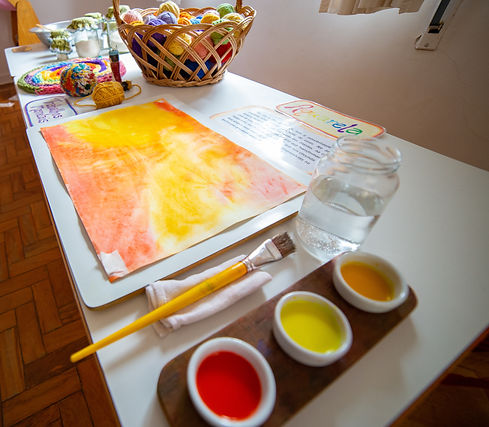
Instead of using text books, the children create their own main lesson books, complete comprehensive projects, hands on activities and creatively present what they learned. The arts and music are seamlessly interwoven into the curriculum.
Co-curricular classes compliment and support the core classes and help fully implement key principles in the Waldorf education. These classes are strengthening and balancing the subtle connections between the body, soul, and mind.
Extracurriculars offered on Fridays are a wonderful time to honor the uniquen interests and endeavors of each child. It is time to honor those in the community that have spent much time and effort to learn a skill, craft, or knowledge in a field and desire to share that knowledge and passion with our children.

Festivals
Waldorf education has a strong emphasis on gratitude, serving, helping, pitching in, and giving back. These attitudes and habits are what will bring much needed goodness and change in the world. It starts with the parents’ attitude and actions - giving worthy role models to emulate. Each parent is required to volunteer time helping in classrooms, field trips, fundraisers, and putting on the amazing school festivals.
The festivals are events held to celebrate the changes in the seasons and mirror the changes in our own lives. They help us recognize needed rhythms and character traits that help us get through and enjoy each season of life. The festivals are a fun and marvelous tradition that allows us to unite through serving, to appreciate the goodness around us, and have a good time together forming positive relationships.
Strengths
Strengths of a Waldorf Education that set them apart from other schools:
-
In accordance with Steiner philosophies, academics like reading and math are not taught until the 6th year of age, 1st grade.
-
Classes advance with their same teacher.
-
The arts, music, drama, reciting and more are heavily incorporated into all the subjects.
-
Many different religions and beliefs are discussed, respected, and taught about when it relates to different learning blocks in geography and history. This is part of promoting cultural awareness and understanding of the amazing variety of people we are sharing this world with.
-
School dress code and uniforms help the children focus on school and see their peers in a more unbiased setting.
-
There is no standardized testing, rather committee and teacher observations record and guide the progress of the student.
-
Technology is not used in the classrooms. Later grades are introduced to it as an extracurricular block. Delayed introduction and careful use of technology, social media, and entertainment connected to screens is strongly encouraged for families to apply at home.
-
The home is where the teaching begins and continues. Waldorf schools believe the attitudes and way things are done at home do affect the way a child will learn and behave at school. Waldorf schools thrive when parents are involved in the learning process, so the school supports parents' in their own learning of journey of parenthood.

Get in Touch
Click on the links to the side to fill out a brief form to be able to stay update with news, events, and ways to contribute.

Form for
Interested Families


Form for
Interested Donors